How can shirt and trouser sizes stay aligned from sample to packing?
Approve separate measurement charts, measuring methods and fitting results for the shirt and trousers. Then define each permitted top-and-bottom combination in a pairing matrix with its set code, quantity, labels and packing instructions. Use that same approved matrix for sampling, ordering, pairing and carton checks.
Fixed pairing suits a product sold in predetermined size combinations. Buyer-specified mixed pairing suits a brand offering combinations for different top and bottom fit needs. For either option, establish the quantity and package identification for each combination before comparing quotes. The linen shirt and resort-set sourcing guide covers fabric and style selection; the steps below address the pairing and handover after a set has been selected.
When should a buyer choose fixed or mixed size pairing?
| Approach | How to specify it | Useful when | Check before ordering |
|---|---|---|---|
| Fixed pairing | Each set size maps to a predetermined shirt and trouser size, such as set M with shirt M and trousers M | The brand sells a set under one size and has approved the pairing through fitting | Set-size mapping, quantity per size, labels and set packing |
| Buyer-specified mixed pairing | List each permitted combination separately, such as shirt M with trousers L | The brand offers different top-and-bottom combinations and can specify demand for each | Quantity by combination, component totals, set codes, sorting and packing checks |
Matching letters do not establish that both garments fit. Use each garment's measurements and the intended wearers' fitting results to approve the relationship. Decide whether the product will display one set size or both component sizes, and state permitted combinations, any separate sales and packing arrangements in the project file.
How should the shirt and trousers be measured separately?
For each garment, record the style and sample revision, size, measurement diagram, method, units, target values and agreed tolerances. Identify flat widths separately from full circumferences; the same letter on two garments does not define identical body or finished-garment measurements.
| Component | Useful points to include | Define in the method |
|---|---|---|
| Shirt | Shoulder width, chest width, body length and sleeve length | Start and end points, front or back length, fastening and flat-lay condition |
| Trousers | Waist, hip width, front and back rise, inseam and leg opening | Flat width or circumference, landmarks, waistband state and leg position |
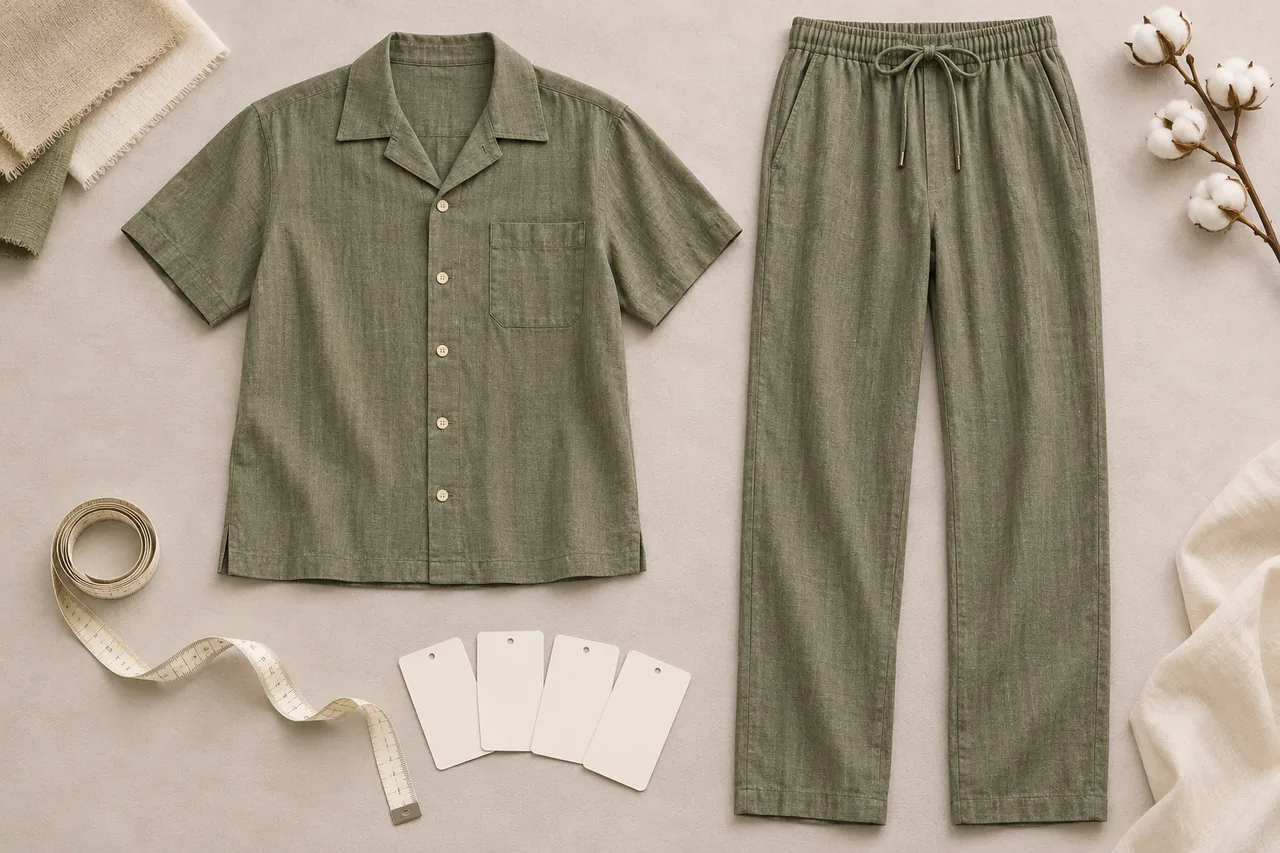
The Cotton Lounge Set with Drawstring Trousers pairs a sage-green short-sleeve camp-collar shirt with full-length white trousers featuring an elastic waistband and front drawstring. For a similar project, record the shirt's shoulder, chest and length separately from the trouser waist and length, then use an outfit fitting to decide the pairing.
The Ivory Camp Collar Shirt and Drawstring Trousers Set combines a tonal short-sleeve shirt with elastic-waist drawstring trousers. For a tonal set, compare both pieces together against the approved color standard as well as measuring them separately, and identify the intended pairing in the packing brief.
How should an elastic waist and drawstring be reviewed?
Define the relaxed waist measurement and any stretched-waist measurement required in the chart. For the relaxed reading, lay the waistband flat without additional pull. For a stretched reading, agree in advance how it is extended, the state at which it is read and the measuring method; use the same method for the recheck. Identify whether each value is a flat width or full circumference.
Specify drawstring length, end finish and adjustment separately. During fitting, record the trouser size, waist adjustment and observations at the waist, hip and leg length while standing, sitting and walking. Keep measured values separate from fit comments: a waist reading can meet its target while the drawstring adjustment still needs review against the brand's requirement.
Fit the shirt in its intended size as well, recording shoulder and chest fit, length and movement. If only the trouser waistband changes, recheck the related measurements, drawstring and fit, then link the revised trouser sample and chart to the set record. The revised sample and size-chart guide explains how to manage the documents.
How does a pairing matrix connect sets to component quantities?
Create one row for each permitted combination, including set code, color, shirt size, trouser size, planned sets and packing instructions. The hypothetical example below contains one shirt and one pair of trousers per set:
| Example set code | Shirt size | Trouser size | Sets | Shirts required | Trousers required |
|---|---|---|---|---|---|
| SET-M-M | M | M | 40 | 40 in M | 40 in M |
| SET-M-L | M | L | 20 | 20 in M | 20 in L |
| SET-L-L | L | L | 30 | 30 in L | 30 in L |
| Total | — | — | 90 | 90 shirts | 90 trousers |
Summed by shirt size, the order needs 60 M shirts and 30 L shirts. Summed by trouser size, it needs 40 M and 50 L trousers. Check that each component total equals the planned set count. Separate or filter the matrix by style and color so quantities from different combinations are not mixed.
The same table instructs packing: SET-M-L requires an M shirt and L trousers. The codes above illustrate the method; the brand defines its own production codes. List any spare individual garments separately from the set quantity.
How should sampling and quotes be compared for the two options?
Give suppliers the same style, fabric, target market and delivery requirements, then submit a fixed-pairing proposal and a buyer-specified combination proposal separately. Each should identify:
- The shirt and trouser size ranges, measurement charts, methods and fitting requirements.
- Each set combination, color and quantity, plus the component totals by garment size.
- Sampling scope: shirt sizes, trouser sizes and complete combinations to review; identify each physical sample and revision.
- Labels and packing: component size labels, set label or barcode, folding, sets per bag, carton assortment and carton marks.
- Quote scope: materials and manufacturing in the set price, pairing and packing, inspection and delivery; list sample making, label or packaging development and other separate charges individually.
Ask suppliers to state the quantity conditions and inclusions for each proposal, then compare total set cost and execution. If a combination, quantity, size or package changes, update the matrix and quotation together. Use the sample-to-bulk consistency checklist to keep approved records connected to production.
What should be checked from sample approval to carton handover?
- Approved file: link the shirt and trouser samples, their respective charts, pairing matrix, color standard and packing sample to one order revision. Record the approver and date.
- Before packing: check style, color, each garment's size label and the required quantity against each matrix row. Inspect the drawstring, appearance and set contents as agreed.
- Set packing: compare folding, bag, hangtags, set identification and barcode with the approved packing sample. The label should identify the actual top-and-bottom combination.
- Carton and reconciliation: record carton number, set code, quantities of each combination and total sets per carton. Inspect or count the two garments inside packages according to the agreed plan, then reconcile carton totals against the order matrix. Record affected combinations and carton numbers when correcting a mismatch or missing piece, and recheck after correction.
The shipment summary should show sets by combination and the shirts and trousers used for those sets. Present any difference between actual packing and the order for the parties to resolve before issuing the final packing records.
Mingsheng Apparel is a custom manufacturer in Dachen Town, Yiwu, Zhejiang, specializing in shirts, Polo shirts and matching sets. It develops patterns and sizes from customer size charts, reference garments and Tech Packs. Send the two garment briefs, measurement charts, proposed pairing matrix and packing requirements through Mingsheng's OEM/ODM service to discuss the sample and order plan.
Frequently Asked Questions
Must a size M shirt always be paired with size M trousers?
No. The brand should approve fixed or buyer-specified mixed combinations using the separate garment charts and fitting results, then document each pairing in the matrix.
How should the waist of elastic-waist trousers be recorded?
Define the relaxed measurement and any required stretched measurement separately. State whether each is a flat width or full circumference, document the measuring method and garment state, and review drawstring adjustment and fit.
How are component quantities calculated for mixed-size sets?
List the number of sets for each shirt-and-trouser combination, then sum shirts by shirt size and trousers by trouser size. When each set contains one of each, both component totals should equal the set total; list spares separately.
What should be checked before a set is packed into a carton?
Compare the style, color, component size labels, set contents and package identification with the approved pairing matrix. Record quantities by combination and carton number, then reconcile them with the order.