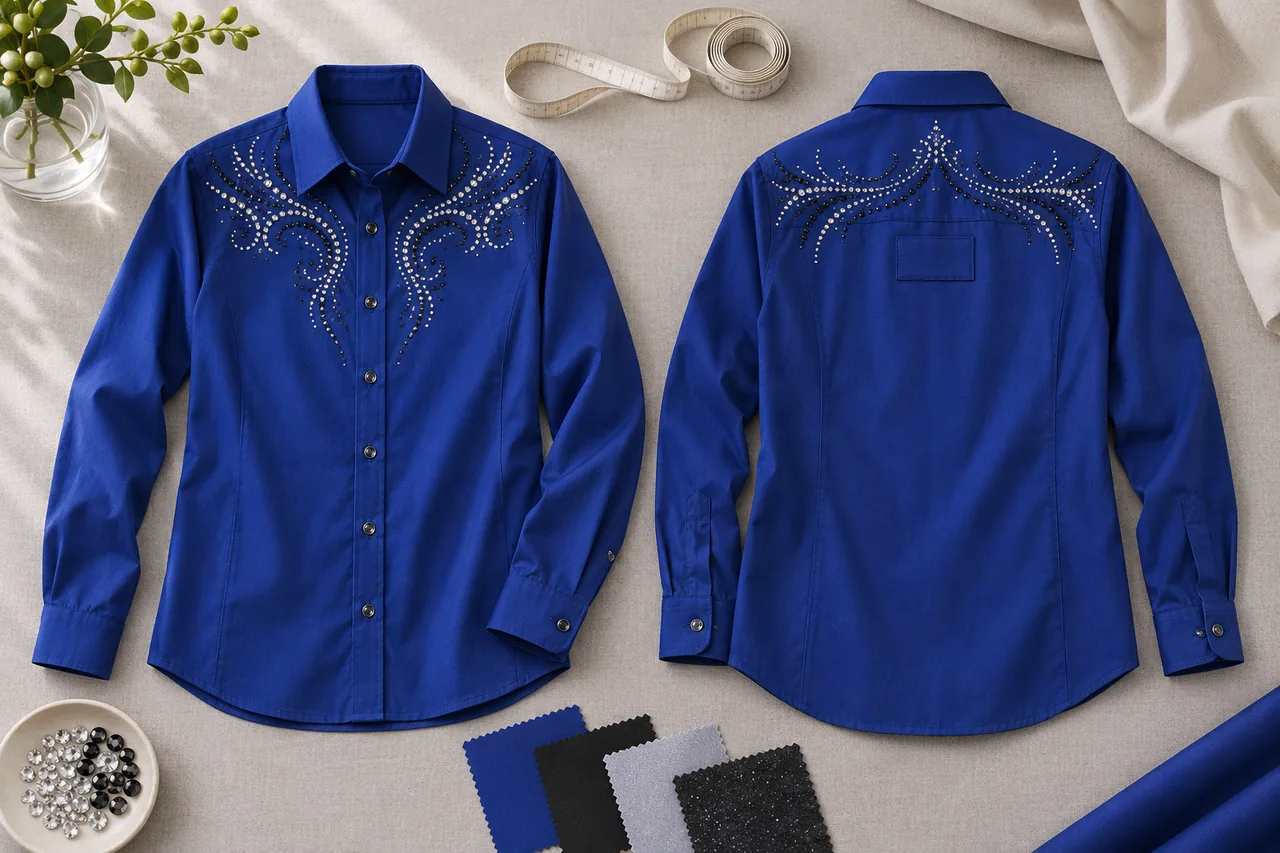
How should buyers specify a shirt with rhinestones on the front and back?
Mark the rhinestone coverage, pattern boundaries, colors and placement landmarks on separate front and back drawings. Show the decoration's relationship to the back patch. Use the same artwork revision for a decorated fabric swatch and a complete shirt sample, then review appearance, placement and post-care results against agreed criteria.
Mingsheng's published style 2026102279 is a royal blue men's casual shirt with silver and black hotfix rhinestones across the upper front and back and a back patch detail. When using a construction like this as a reference, mark the front decoration, back decoration and patch relationship separately, along with the details to retain or change in your own design.
Which landmarks belong on the placement drawings?
Prepare front and back garment flats and assign an ID to each motif group. Identify the base size, garment panels and main seams. Use landmarks that can be found consistently on the finished shirt.
| Area | Specify on the drawing | Check on the sample |
|---|---|---|
| Front chest | Motif boundary, width and height; distance from center front or placket edge and shoulder seam | Measure from the specified landmarks with the garment flat; review the left and right arrangement |
| Upper back | Motif boundary and distance from center back, shoulder seam or back-yoke seam | Measure overall placement and review the left and right relationship |
| Around the back patch | Patch outline and position, distance between patch and decoration, and whether overlap is intended | Check spacing, edge relationship and patch appearance |
| Across sizes | Whether motif dimensions or placement change with size | Review against the drawing or measurement table for each size |
State whether a distance is measured to the center or outside edge of a stone, or to the motif boundary. Record the target and tolerance agreed by buyer and supplier. For a symmetrical design, identify the comparison line; for an intentionally asymmetrical design, show each side separately.
Turn the artwork and rhinestones into a sampling brief
Create a list for each stone type with its color, shape, size or supplier reference, placement group and count. Give the artwork a revision ID and show overall dimensions, color distribution, stone spacing and direction. Use distinct symbols for similar colors and approve them alongside physical stones.
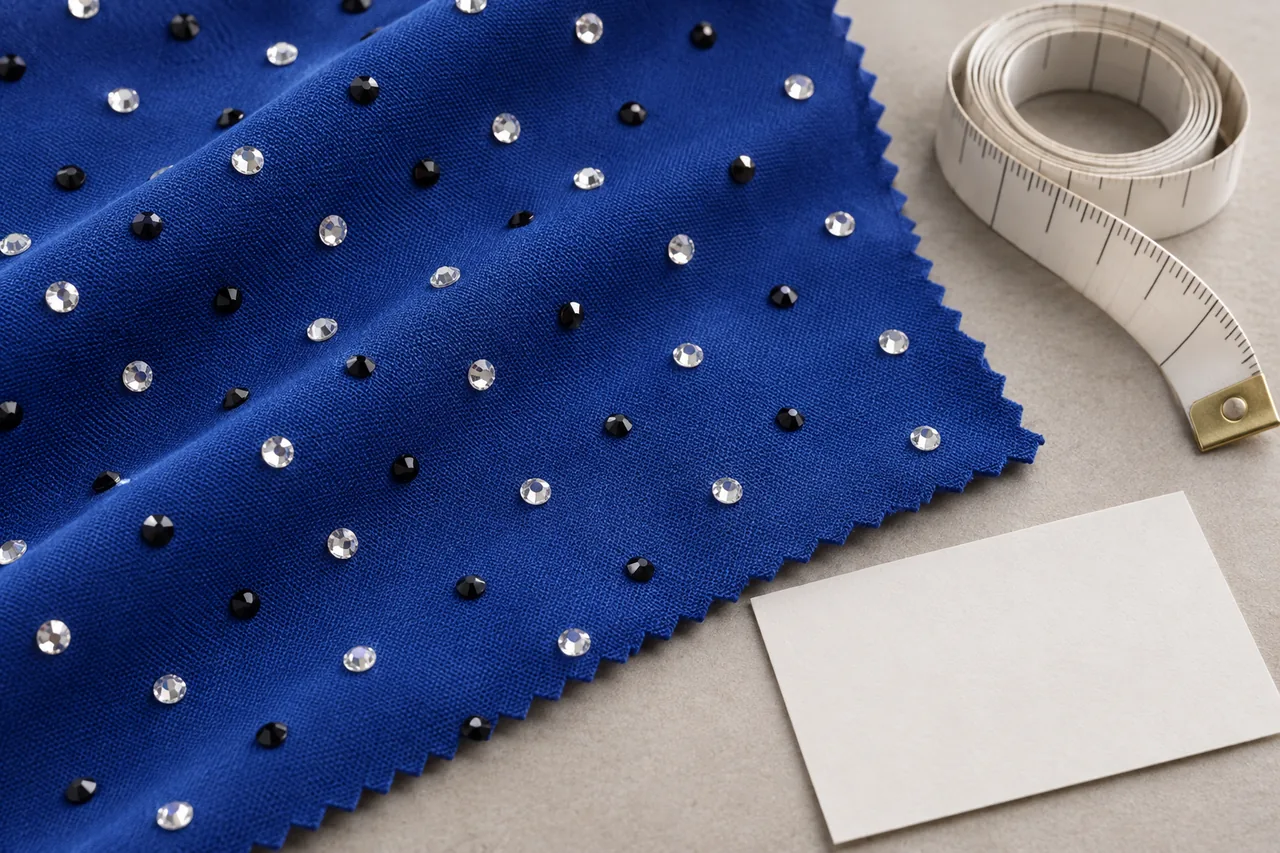
Keep the fabric swatch with the artwork, identified by color and fabric reference. Ask the maker to explain the rhinestone materials, decorated-swatch and garment-sample arrangements, and record the materials used. A decorated swatch on the intended fabric lets the buyer review stone colors, arrangement and appearance before assessing the complete shirt.
What should be approved on the swatch and complete shirt?
| Review item | Check | Record |
|---|---|---|
| Decorated swatch | Fabric and stone combination, color contrast, arrangement, stone surface and surrounding appearance | Swatch ID, fabric and stone references, photos and approval comments |
| Complete shirt | Front and back placement, motif dimensions and count, patch relationship and worn silhouette | Front, back and detail photos, measurements and revision list |
| Artwork or samples by size | Whether motif dimensions are scaled or fixed, and their placement relative to the body | Placement table and approval for each size |
Lay the shirt naturally flat and measure both motifs using the agreed drawing. Check each group's colors, count and arrangement, including missing, incorrect, crooked or damaged stones and conspicuous adhesive marks. Review the motif's relationship to the patch edges, placket and seams. On the wearer, observe front and back placement and the shirt's silhouette; record visual observations separately from measurements.
Write each revision as area, observation, target and recheck method. For example, when moving a back motif farther from the patch, identify the two edges used for measurement, the target distance and tolerance on the drawing, then check the revised sample. The second-sample and size-chart revision guide explains how to keep the garment and documents aligned.
How should rhinestones be checked after care?
Before treatment, record the garment or swatch ID, fabric and stone revisions, count each motif group, photograph the front, back and details, and note the initial appearance. Before testing, buyer and supplier should agree the washing, drying and pressing procedure, number of cycles and condition for the post-care review.
After treatment, compare the same areas under consistent viewing conditions. Recount the stones and record detachment, movement, changes to stone surfaces, adhesive marks and surrounding fabric appearance. Agree the acceptance criteria, number of specimens and reporting format in advance. If laboratory testing is required, agree with the laboratory on a method, specimens and decision criteria suited to the product and the intended assessment.
A decorated swatch supports comparison of the material combination; a complete shirt also shows the decoration's relationship to the body, patch and seams. Record the results separately against each sample ID and care procedure.
How do quotations and first-bulk approval connect?
Request separate prices for buyer-supplied-material processing, a finished shirt with factory-sourced materials, and sampling. State who supplies the stones and patch; whether artwork and decorated swatches are charged separately; and whether finishing, packing, inspection, taxes and freight are included. Link each quotation to the quantity, color and size breakdown, and stone specification.
If sample review changes the stone count, colors, motif dimensions or patch construction, revise the artwork and specification and request an updated quote. Once approved, link the reference sample, placement drawings, stone list, fabric swatch, care-review record, size chart and acceptance criteria under one revision. Check the first bulk piece against that set, then include the agreed points in in-process and finished-garment inspection. Record the location, quantity and resolution of any issue. See the shirt sample-to-bulk consistency checklist and shirt production quality control process for the wider handover.
Mingsheng Apparel is a custom manufacturer in Dachen Town, Yiwu, Zhejiang, specializing in shirts, Polo shirts and matching sets. It develops patterns and sizes from customer size charts, reference samples and Tech Packs. Send front and back drawings, rhinestone and patch requirements, fabric, quantities and acceptance criteria through Mingsheng's OEM/ODM service to discuss sampling and a quotation.
Frequently Asked Questions
Where should rhinestone placement be measured from?
Identify repeatable landmarks on the front and back drawings, such as center front, the placket edge, center back or a seam. State whether the measurement ends at a stone's center, its outside edge or the motif boundary, and record the agreed target and tolerance.
What is the difference between a decorated swatch and a complete shirt sample?
The swatch is used to review stone color, arrangement and appearance on the intended fabric. The complete shirt is used to review front and back placement, dimensions, the patch relationship and the worn silhouette. Both should refer to the same artwork and material revision.
What should be recorded after washing a rhinestone sample?
Record stone counts and photographs before treatment. Follow the agreed washing, drying and pressing procedure and number of cycles, then record detachment, movement, changes to stone surfaces, adhesive marks and surrounding fabric appearance against the agreed acceptance criteria.
How should a quote change when the stone count or patch changes?
Revise the artwork, stone list and affected construction requirements. Ask the supplier to recalculate buyer-supplied-material processing, full-package production and sampling separately, with materials, packing, inspection and freight clearly included or excluded.