How should buyers specify a front-and-back pintuck shirt?
Mark the coverage, number, finished width, spacing, direction and endpoints of the pintucks on front and back drawings. Agree on measurement landmarks, tolerances and a care procedure, then review the same sample flat, on the body and after washing.
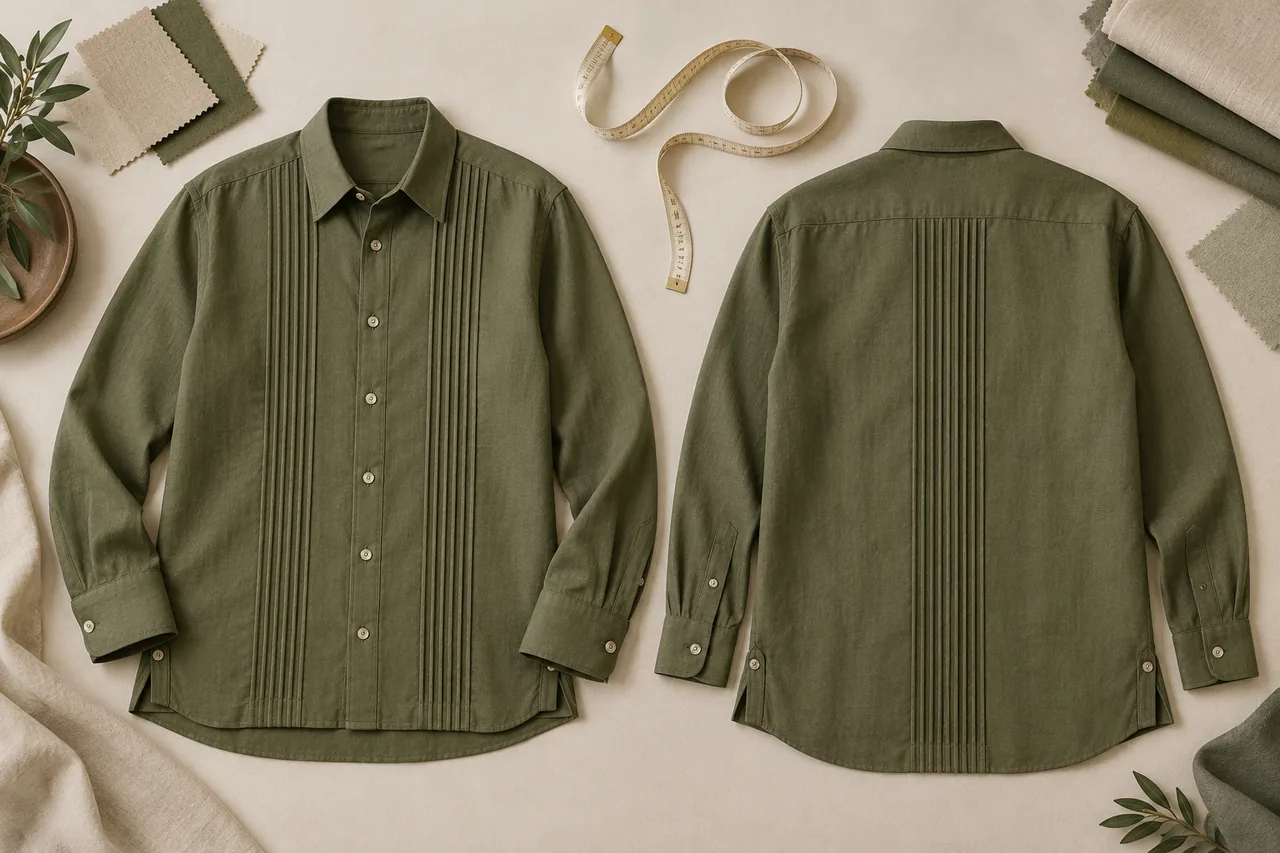
Mingsheng's published style 2026101777 is an olive-green men's long-sleeve shirt with vertical pintucks on both front sides and at the center back. It also has a back yoke, wide cuffs and buttoned openings at both side hems. Use this construction as a starting point, then mark the details you want to retain or change on your own design.
Distinguish decorative pintucks, a back pleat and darts
| Construction | What the buyer should describe | What to check on the sample |
|---|---|---|
| Decorative pintucks | The intended visual arrangement on the front or back | Number, width, spacing, placement, length and appearance |
| Back pleat for ease | Desired movement allowance and pleat location | Pleat form, fold amount and how it opens during movement |
| Dart | The area and body shape to be adjusted | Dart endpoints, intake and fit on the wearer |
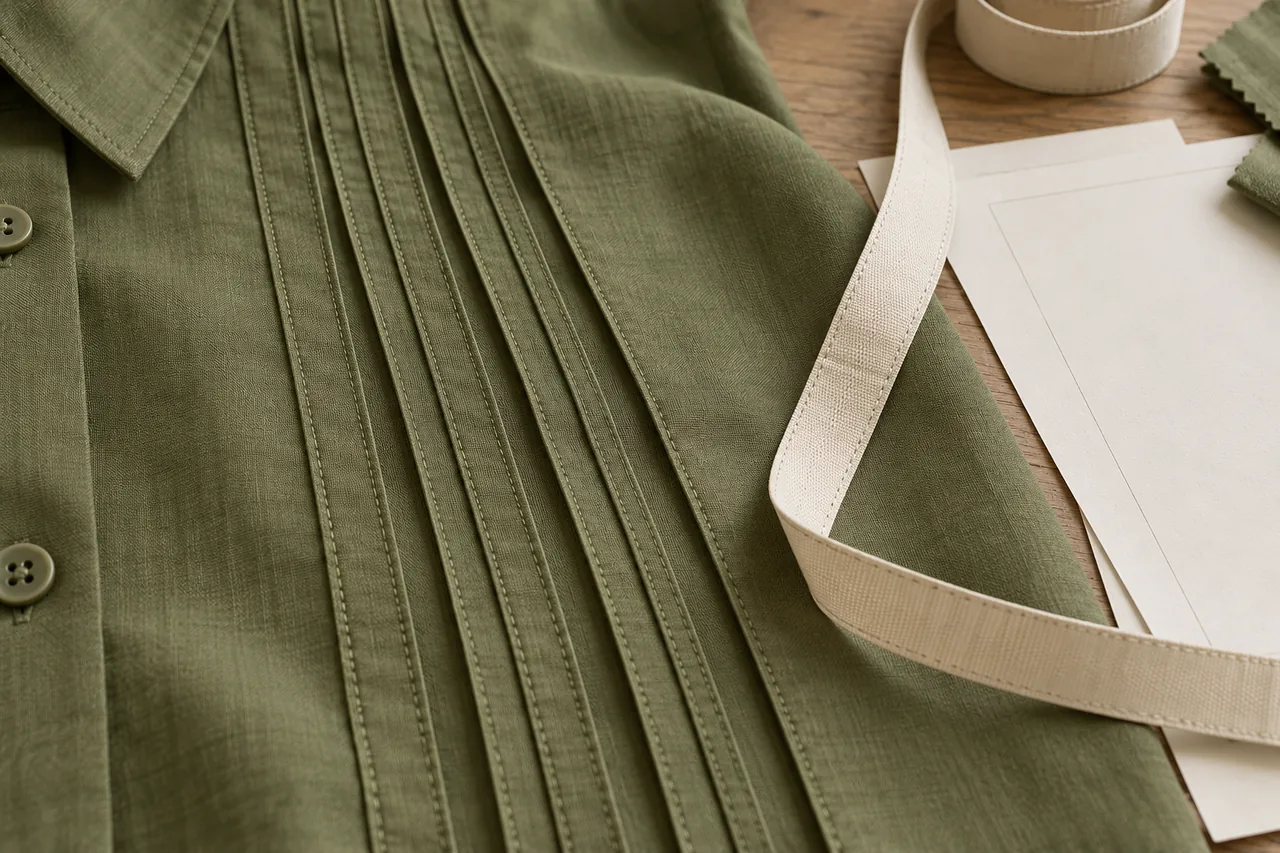
Each detail needs its own instructions. Use a close-up or drawing to show the intended pintuck arrangement; discuss chest and waist measurements and fit observations separately with the pattern team. See the shirt dart and waist-shaping guide for shaping details.
What pintuck measurements belong on the sampling drawing?
Prepare separate front and back flats, number each group of pintucks and identify the base sample size. Add the following finished-garment requirements:
| Item | Record on the drawing and specification |
|---|---|
| Coverage | Which front panels and back area carry the pintucks, with placement referenced to the placket edge, front center or back center |
| Number and direction | Number in each group, vertical direction and whether the front groups should mirror one another |
| Finished width | Target width of each pintuck, measuring location and permitted tolerance |
| Spacing | State whether the measurement is edge to edge or center to center; record the target and tolerance |
| Start and end points | Use clear landmarks such as the shoulder seam, back-yoke seam or hem, and mark distances to each endpoint |
| Construction and grading | Fold direction, stitching and end finish; whether pintuck count, spacing and placement change by size |
The buyer and factory set the values for the design together. If the front groups should be symmetrical, identify the comparison line and tolerance; if they are intentionally different, show each placement separately. Keep the fabric swatch, color, size chart and measuring diagram in the same revision as the pintuck drawing.
How should the yoke, cuffs and side-hem openings be reviewed?
Using the published construction of style 2026101777 as a reference, include these neighboring details in the sample brief:
- Back yoke and pintucks: mark the yoke seam and the pintuck group's position relative to the center back. Define where the pintucks start and end and how they meet the seam.
- Wide cuffs and sleeve plackets: specify finished cuff measurements, button positions and sleeve-placket closure. Check hand passage and fastening during the fitting.
- Buttoned side-hem openings: specify the length and button position on each side and the desired closed-hem appearance. Open and close them to review how the front and back panels meet.
These are ways to document and review the design. The project's drawings and approved sample establish its actual counts, distances and measurements. For an in-person review, see the Dachen factory sample-review guide.
What should be checked flat, worn and after washing?
- Flat measurement: lay the shirt naturally in the agreed condition. Measure pintuck width, spacing and endpoints from the landmarks on the drawing. Record target, actual value and tolerance; count each group and inspect the arrangement, symmetry where specified, stitching and end finishes.
- Worn review: fasten the intended size and inspect the direction of the front and back pintucks, the body silhouette and any local pulling. Record observations during movements such as raising the arms and sitting; also check the cuffs and side-hem openings.
- Post-care review: record the sample ID, measurements and detail photographs before washing. Follow the agreed wash, drying and pressing procedure. Once the shirt reaches the agreed measuring condition, repeat the same measurements and compare pintuck alignment, flatness and endpoint appearance with the original photographs and agreed requirements.
Use an approved garment and detail photographs to describe visual expectations, including arrangement, acceptable waviness and end finish. Record measurement and fit decisions separately so each requested revision identifies the affected area.
How should revisions, quotes and the first bulk piece connect?
Write each revision as location, observation, target and recheck method. After changing pintuck width, count or spacing, remeasure the related body dimensions and review the front and back arrangement, yoke junction and worn silhouette. Link the new sample ID to the revision list and updated size chart; see the second-sample and size-chart revision guide.
Ask for separate prices for buyer-supplied-material processing, a finished shirt with factory-sourced materials, and sample making. State the pintuck specification, materials, quantity, size ratio and whether pressing, packing, inspection and freight are included. Update the specification and quote together when the pintuck plan changes.
After approval, keep the sealed sample, front and back placement drawings, pintuck measurements and tolerances, material swatch, size chart, care procedure and photographs under one revision. Check the first bulk piece against that set, then include the agreed points in in-process and finished-garment inspection. The sample-to-bulk consistency guide covers the broader handover.
Mingsheng Apparel is a custom manufacturer in Dachen Town, Yiwu, Zhejiang, specializing in shirts, Polo shirts and matching sets. It develops patterns and sizes from customer size charts, reference samples and Tech Packs. Send front and back drawings, pintuck annotations, fabric direction, measurements, quantity and acceptance requirements through Mingsheng's OEM/ODM service to discuss the sample.
Frequently Asked Questions
How should the spacing between pintucks be measured?
Agree whether spacing is measured from edge to edge or center to center. Lay the shirt flat and record the target, actual reading and tolerance at the location identified on the drawing.
What should be rechecked after changing pintuck width or count?
Remeasure related body dimensions and review the front and back arrangement, the junction with the back yoke and the worn silhouette. Carry the changes into the revised construction drawing and size chart.
How should a pintuck sample be compared after washing?
Record the sample ID, key dimensions and detail photographs before washing. Follow the agreed washing, drying and pressing procedure, then remeasure in the agreed condition using the same points and compare pintuck arrangement and flatness.
What should a buyer send for a pintuck-shirt quote?
Provide front and back drawings, pintuck placement and measurements, fabric requirements, a size chart, quantities by color and size, packing and acceptance requirements. Ask for material-supplied processing, full-package production and sampling to be priced separately.