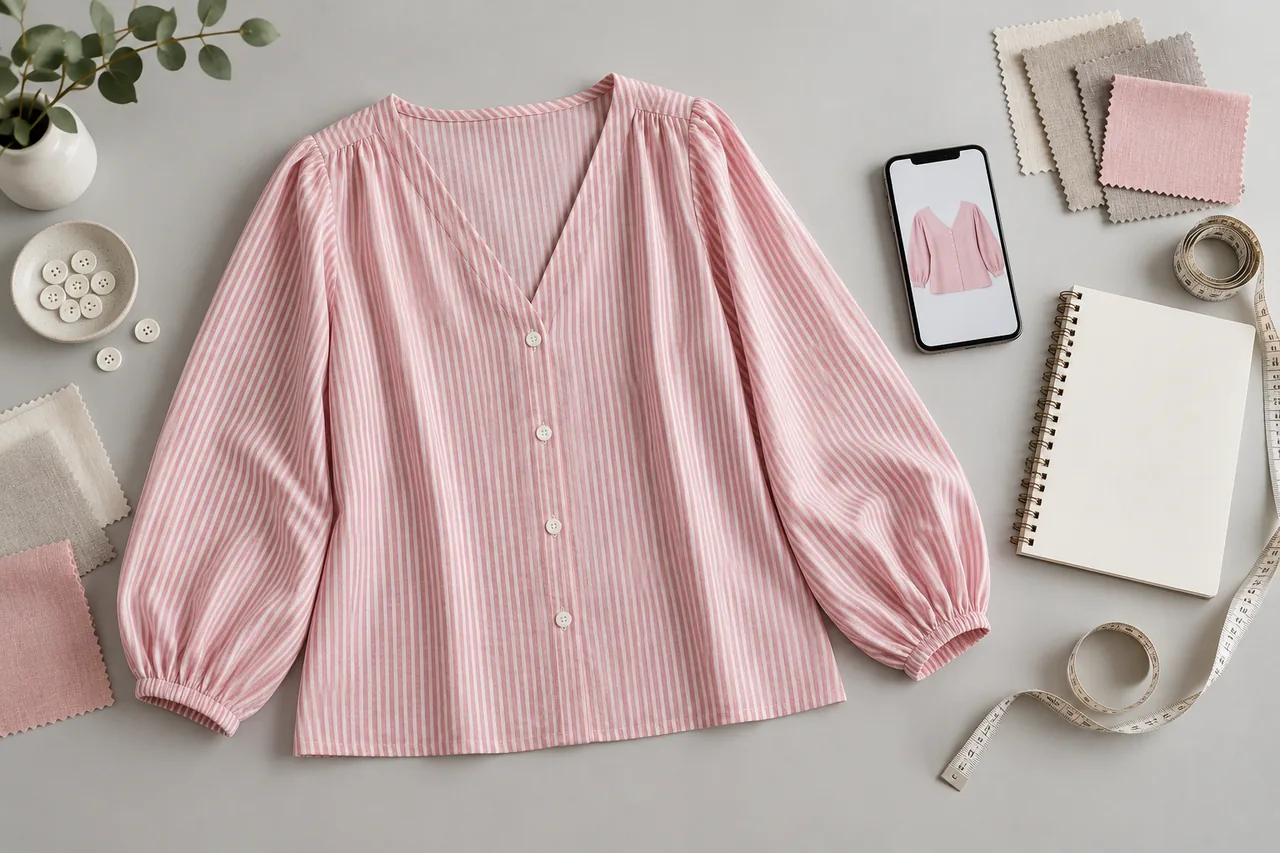
A photo is enough to start a blouse quotation. Add the order quantity, identify who supplies the fabric and trims, and annotate the neckline, placket and cuffs. Ask the factory to return its costing assumptions with the price so you can compare the same garment and scope.
Consider a pink striped, V-neck, button-front blouse with loose sleeves and gathered cuffs. The first task is to turn its appearance into a usable request for quotation, or RFQ. The broader cost categories are explained in our shirt OEM quotation and cost breakdown.
Which details should you mark on the blouse photo?
Number the main construction areas on one image. Keep the desired appearance separate from the construction proposal the factory needs to develop.
| Area | What to describe | Useful supporting detail |
|---|---|---|
| V-neck | Opening depth and width; inside finish | Close-up, base-size measurement or reference sample |
| Button placket | Opening, finished width and button specification | Inside view, button spacing and buttonhole direction |
| Loose sleeve | Length, sleeve width and movement allowance | Flat measurements or a target size chart |
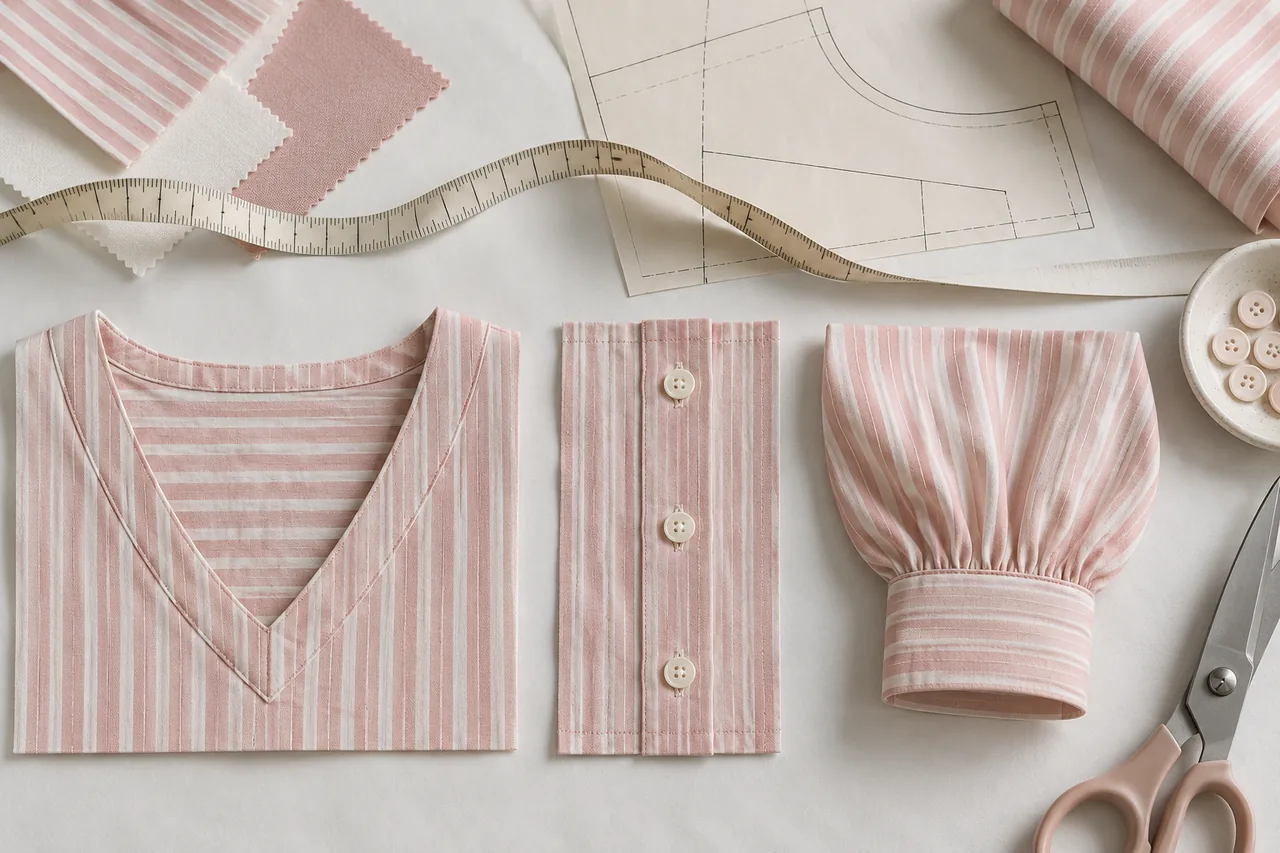
| Gathered cuff | Finished opening and how the hand passes through | Inside and outside views; elastic width and length if used |
| Stripes | Grain direction and seams requiring alignment | Fabric swatch, stripe repeat and marked matching positions |
After the front view, prioritize a full back view and close-ups of the inside neckline, placket and cuff. These help establish back-panel construction, finishing, placket layers and the gathering method. Refer to the same image numbers in subsequent comments.
State who supplies materials before asking for the CMT price
Open with either “We will supply the fabric and trims; please quote cutting and manufacturing” or “Please source the agreed fabric and trims and quote the finished blouse.” For a mixed arrangement, assign responsibility for fabric, buttons, elastic, labels and bags individually.
A CMT request should still specify whether buttonholes, button attachment, pressing, inspection and bagging are included. A full-package request also needs sourcing specifications. EXW and FOB describe delivery responsibilities; they do not replace a material-supply agreement or define the development services included.
Copy this photo-based blouse RFQ
Complete the available fields and attach the numbered images. Where you have not selected a material or construction, ask for a defined proposal rather than “make it exactly like the picture.”
Please develop a striped V-neck, button-front blouse based on the attached images, retaining the loose sleeve and gathered-cuff design.
Planned quantity: [fill in] units. Colors and quantity per color: [fill in]. Size range and ratio: [fill in].
Supply arrangement: buyer supplies [fill in]; factory sources [fill in]. Please separate manufacturing and material costs.
Fabric: specification or swatch attached as [fill in]; alternatively, please propose fabric for [fill in] season, [fill in] weight and [fill in] drape.
Base-size measurements or reference sample: [fill in]. Stripe directions and matching positions are marked on the images.
Labels and packaging: [fill in]. Delivery point and target timing: [fill in].
Please return the proposed construction and materials, included operations, quantity basis, unit price, development and sampling charges, separately charged items, and the information needed before sampling.
As development progresses, consolidate measurements, measurement methods, construction and revisions into one specification. Our shirt sample and pattern-development guide explains how those services relate to the sample stage.
What makes the initial quote useful for the next decision?
Look for five things alongside the price: order breakdown, proposed materials, included operations, one-time charges, and the delivery point with the conditions that start the production schedule. Request missing items before selecting a sampling proposal.
Use the sample to review fit, neckline opening, placket appearance and cuff access. If sampling changes the panels, finishes or materials, align the quotation with the revised specification. Carry that revision into sample-to-bulk consistency checks.
Based in Dachen Town, Yiwu, Zhejiang, Mingsheng develops women's shirts from customer images, reference samples, measurement charts and tech packs. Send a blouse development and quotation request with your images and RFQ to establish the construction and scope before sampling.
Frequently Asked Questions
Can I request a blouse manufacturing quote with only a photo?
Yes. Send the photo with the planned quantity, material-supply arrangement and target delivery timing. Ask the factory to state the construction, materials and operations used for its initial costing. Add back, neckline, placket and cuff-detail photos before progressing to the sample.
How is a CMT quote different from a full-package blouse quote?
A customer-supplied-material or CMT quote must identify the materials supplied by the buyer and the cutting, sewing, finishing, inspection and packing included. A full-package quote also identifies the fabrics, trims and packaging the factory will source. Compare the stated scope alongside the unit price.
How do I request a quote before choosing the fabric?
Describe the intended season, weight, drape and opacity, and request separately priced fabric proposals. Record composition, construction, weight, usable width and supply conditions for each proposal before fixing fabric consumption and the garment price.
What should happen after the first quote?
Check the quantity, construction and material assumptions, then select a development proposal. Use the sample to approve measurements, neckline, placket and cuff construction, and update the specification and quotation to the same revision.